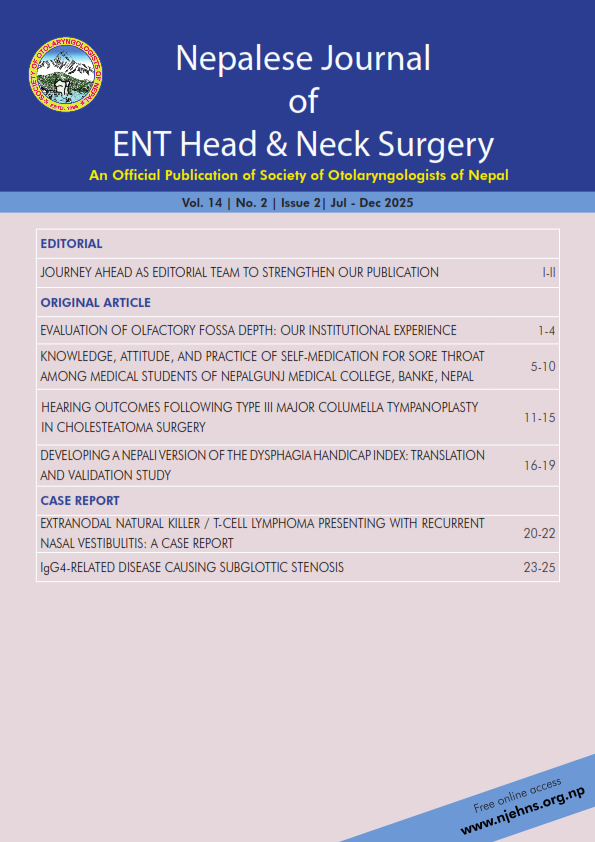
Developing a Nepali Version of the Dysphagia Handicap Index: Translation and Validation Study
Abstract
Aims and Objectives: Dysphagia affects multiple aspects of daily functioning, highlighting the need for valid patient-reported outcome tools. The Dysphagia Handicap Index (DHI) is used globally as a standard tool, but no validated Nepali version exists. This study aimed to translate, culturally adapt, and validate the DHI for use within the Nepali-speaking population.
Methods: Standard method of translation-back-translation was utilized where English version of DHI was translated and customized by four professors with degree in Nepali language. Later it was administered on 20 native literate Nepali speakers whose first language was Nepali for content validity. The final translated version DHI was administered on 100 individuals. The data was analyzed using SPSS version 20.
Results: The scale demonstrated excellent internal consistency, with a Cronbach’s α of 0.976 and McDonald’s ω of 0.977, indicating high reliability across all items. The inter-item correlation coefficients predominantly ranged from 0.50 to 0.85, reflecting moderate to strong positive correlations among items.
Conclusion: Overall, the scale shows strong psychometric performance, comparable to international DHI versions. Its high reliability and coherent item structure confirm its robustness. These findings support its use in clinical assessment and dysphagia research.
Keywords: Dysphagia, Deglutology, DHI, Handicap, Nepali
Downloads
Published
How to Cite
Issue
Section
License
Copyright (c) 2026 Nepalese Journal of ENT Head & Neck Surgery

This work is licensed under a Creative Commons Attribution-NonCommercial 4.0 International License.